
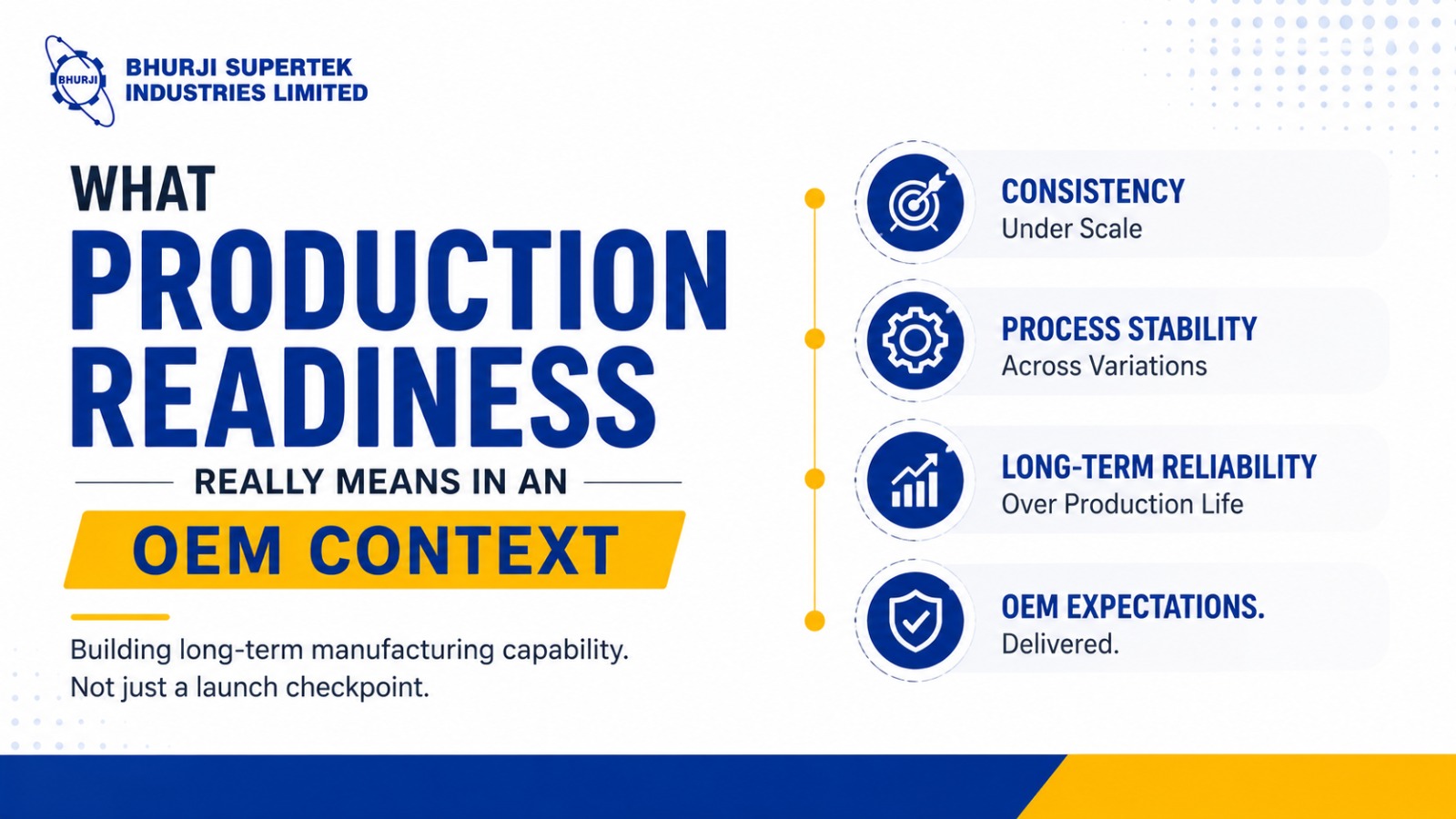
What “Production Readiness” Really Means in an OEM Context
In OEM manufacturing environments, “production readiness” is often misunderstood as a milestone achieved once tooling is delivered, trials are completed, and production begins.
In reality, true production readiness goes far beyond initial approval samples or successful trial runs.
For OEMs operating in automotive, consumer durables, electronics, industrial equipment, and engineered plastic components, production readiness is not about whether a tool can produce parts once. It is about whether the entire manufacturing ecosystem can sustain precision, repeatability, and performance consistently under real production conditions.
At Bhurji Supertek Industry Limited, production readiness is approached as a long-term manufacturing capability—not a short-term launch checkpoint.
Production Readiness Is About Stability Under Scale
Many tooling programs perform well during controlled trials but begin showing inconsistencies once production volumes increase.
This happens because production readiness is not validated during isolated conditions alone. It is validated when a tool operates continuously under:
- High-cycle production demands
- Variable thermal loads
- Extended operational hours
- Material behavior fluctuations
- Repetitive mould opening and closing cycles
- Real-world shop floor conditions
A mould that delivers dimensional accuracy for 500 shots but struggles at 50,000 cycles is not truly production-ready.
OEM environments demand tooling systems capable of sustaining consistency over extended production lifecycles—not just during sampling stages.
OEM Expectations Extend Beyond Part Approval
In many projects, suppliers focus heavily on achieving sample approval while underestimating broader OEM production expectations.
However, OEMs evaluate production readiness through multiple operational parameters:
- Dimensional repeatability
- Process stability
- Tool durability
- Cycle time consistency
- Maintenance predictability
- Cavity balance performance
- Ease of process integration
- Long-term production efficiency
A tool may technically produce acceptable parts, yet still fail OEM expectations if it introduces instability, excessive downtime, or unpredictable maintenance requirements during mass production.
This is where process-driven tooling expertise becomes critical.
Tooling Readiness and Process Readiness Are Not the Same
One of the most common industry misconceptions is assuming that completed tooling automatically translates into production readiness.
In reality, production readiness involves synchronization between:
- Tool design
- Machine capability
- Process parameters
- Cooling efficiency
- Material flow behavior
- Automation compatibility
- Operator handling consistency
- Inspection systems
Without process alignment, even high-precision tooling can experience:
- Flash variation
- Uneven filling patterns
- Warpage inconsistencies
- Cooling imbalance
- Premature wear
- Productivity fluctuations
True OEM readiness is achieved only when tooling and process engineering function as one integrated system.
The Hidden Importance of Process Repeatability
OEM manufacturing environments are built around predictability.
Production schedules, supply chains, assembly operations, and inventory planning all depend on stable process output. This is why repeatability often matters more than occasional peak performance.
Production-ready tooling must consistently deliver:
- Stable cycle times
- Uniform cavity performance
- Controlled shrinkage behavior
- Minimal rejection rates
- Repeatable dimensional accuracy
- Long operational reliability
The challenge is not producing one perfect batch. The challenge is producing identical quality across millions of cycles with minimal process deviation.
This level of repeatability can only be achieved through disciplined engineering, robust validation methodologies, and controlled manufacturing systems.
Why Early-Stage Engineering Decisions Matter
Production readiness is heavily influenced by decisions made long before machining begins.
Critical factors include:
- Part design feasibility analysis
- Gate location optimization
- Cooling channel engineering
- Steel selection
- Venting strategy
- Tolerance stack-up planning
- Mold flow considerations
- Maintenance accessibility design
Poor early-stage engineering often creates downstream production instability that inspection systems alone cannot resolve.
At BSIL, engineering and manufacturing teams work with a process-oriented mindset where tooling is developed not only for dimensional compliance, but for long-term production sustainability within demanding OEM environments.
OEM Production Readiness Requires Cross-Functional Thinking
In modern manufacturing ecosystems, production readiness is no longer isolated to tooling departments alone.
It requires coordination between:
- Design engineering
- Tool manufacturing
- Process engineering
- Quality control
- Automation integration
- Production planning
- Maintenance teams
A technically accurate mould that disrupts automation efficiency or creates unstable cycle times can negatively impact entire production ecosystems.
This is why mature OEM suppliers focus not only on part quality, but on manufacturing compatibility, process reliability, and operational scalability.
Production Readiness Is Proven Over Time — Not During Trials Alone
Initial sample approvals provide confidence. Sustained performance builds trust.
OEMs ultimately judge production readiness based on:
- Long-term process stability
- Production uptime
- Consistent output quality
- Reduced downtime events
- Tool maintenance predictability
- Scalability across production volumes
The true measure of production readiness is not how a tool performs during inspection—it is how reliably it performs during continuous production pressure.
Conclusion
In an OEM manufacturing context, production readiness is not simply about starting production. It is about sustaining controlled, repeatable, and scalable manufacturing performance over time.
It requires more than accurate tooling. It demands:
- stable processes,
- intelligent engineering,
- operational predictability,
- and manufacturing systems designed for long-term reliability.
At Bhurji Supertek Industry Limited, production readiness is viewed as an engineering responsibility that extends beyond tool delivery—focused on building manufacturing solutions capable of performing consistently under real-world OEM production demands.
Because in precision manufacturing, readiness is not defined by whether production can begin.
It is defined by whether production can continue reliably, efficiently, and at scale.


Leave a Reply