
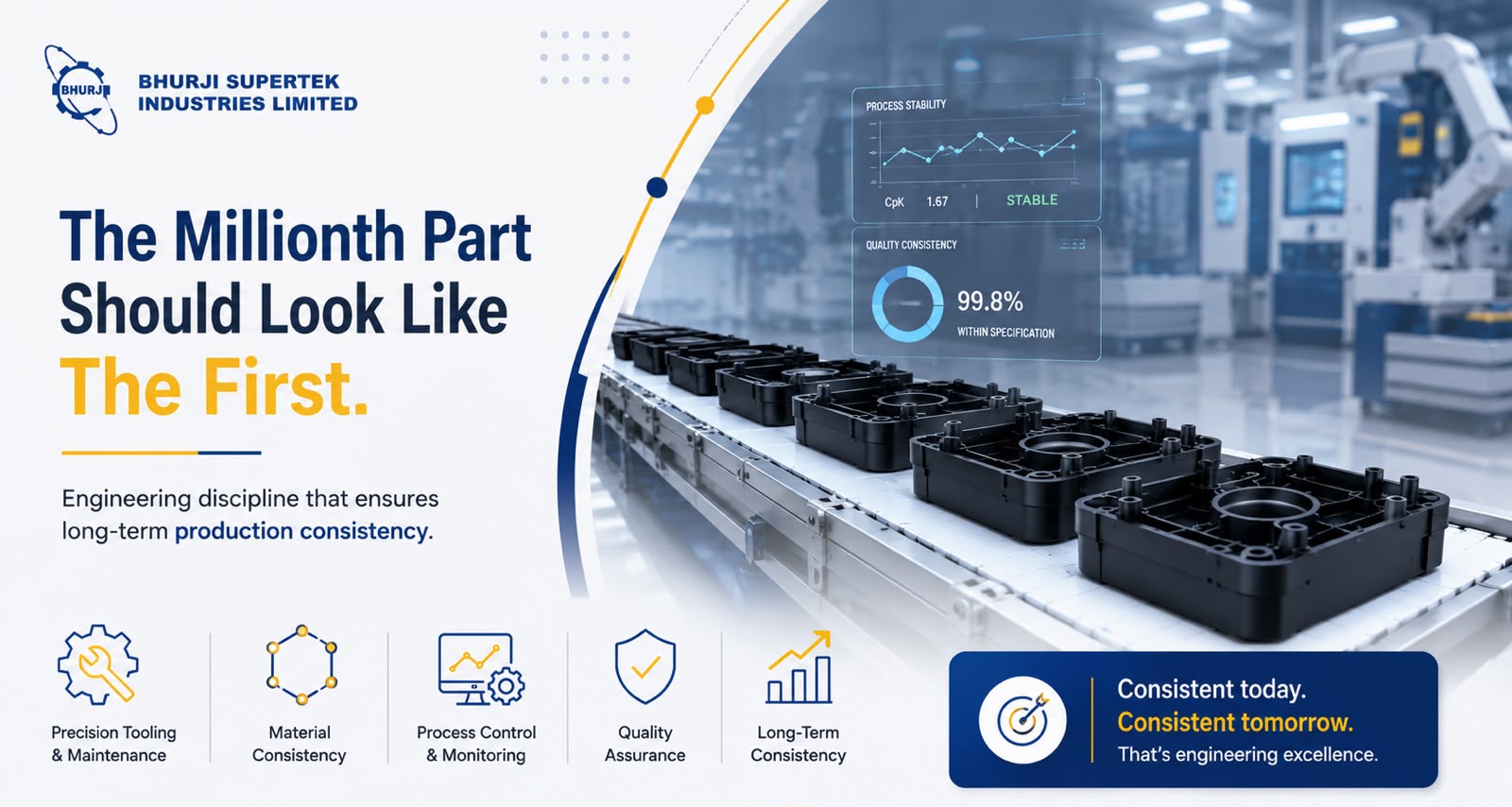
Why Your Plastic Component Looks Different in Month 8 Than It Did in Month 1?
Understanding the Engineering Factors Behind Long-Term Production Consistency in OEM Manufacturing
The first production sample often receives the greatest attention during product development.
Dimensions are verified.
Surface finish is inspected.
Assembly compatibility is validated.
Functional performance is confirmed.
Once the component successfully passes validation, it is easy to assume that production consistency will naturally continue throughout the programme.
In reality, this is where the real engineering challenge begins.
Maintaining identical product quality over several months—or even years—of continuous production demands far more than an accurately manufactured mould or a capable injection moulding machine. It requires disciplined tooling maintenance, robust process engineering, material understanding, and continuous production monitoring.
When brands notice subtle differences in a plastic component several months into production, the cause is rarely a single event. More often, it is the cumulative effect of small engineering variables that naturally evolve throughout the production lifecycle.
Understanding these variables is essential for appreciating why long-term manufacturing consistency is considered one of the strongest indicators of OEM capability.
Initial Approval Demonstrates Capability. Long-Term Production Demonstrates Manufacturing Excellence.
A successful first-off sample confirms that a product can be manufactured according to specification.
However, OEM manufacturing programmes rarely consist of a few hundred parts.
Many programmes require moulds to produce hundreds of thousands—or even millions—of components while maintaining identical dimensional accuracy, cosmetic appearance, and assembly performance.
This significantly changes the engineering objective.
The focus shifts from producing an acceptable component once to producing the same component consistently throughout the life of the programme.
As manufacturing professionals often say,
“Anyone can celebrate a successful trial. The real achievement is making sure nobody notices the millionth component because it looks exactly like the first.”
This is where manufacturing discipline becomes just as important as manufacturing capability.
Every Mould Evolves Throughout Its Operational Life
Injection moulds are precision-engineered assets designed for long production cycles.
However, every production cycle subjects the tool to thermal loading, mechanical movement, material flow, and continuous operational stresses.
Slides operate repeatedly.
Shut-offs engage under pressure.
Gates experience constant polymer flow.
Cooling channels complete thousands of heating and cooling cycles.
These changes are not signs of poor tooling.
They represent the normal operating behaviour of every production mould.
The difference lies in how these natural changes are anticipated and controlled.
Structured preventive maintenance, periodic dimensional verification, cavity inspections, wear monitoring, and planned refurbishment programmes enable manufacturers to preserve tooling accuracy throughout extended production runs.
An experienced toolmaker once remarked,
“A mould never surprises you. It tells you exactly how it’s ageing. The question is whether you’re listening before the customer does.”
This observation captures the philosophy behind mature tooling management.
Visible component variation is often preceded by subtle engineering indicators that can be identified long before they affect production quality.
Material Consistency Goes Beyond Material Specifications
Another common assumption is that using the same polymer grade automatically guarantees identical production outcomes.
While material specifications establish performance standards, polymer behaviour remains influenced by processing conditions.
Modern engineering polymers may exhibit subtle differences in:
- Melt flow behaviour
- Moisture absorption
- Thermal response
- Viscosity characteristics
- Shear sensitivity
These variations remain well within approved specifications, yet they can still influence material flow inside a precision mould.
Experienced manufacturers therefore understand that selecting the correct material is only one part of the equation.
Maintaining consistent processing conditions throughout production is equally important.
As one polymer processing specialist appropriately stated,
“The polymer doesn’t know what the specification sheet says. It only responds to heat, pressure and physics.”
This is precisely why successful OEM manufacturing combines material science with process engineering.
Process Drift Is Often Invisible Until It Becomes Visible
Unlike sudden equipment failures, gradual process drift rarely announces itself.
Instead, it develops progressively.
Minor adjustments following machine maintenance.
Small variations in holding pressure.
Changes in cooling efficiency.
Seasonal environmental conditions.
Routine optimisation carried out during production.
Each individual adjustment may appear insignificant.
Collectively, however, they gradually create a manufacturing process that differs from the one originally validated.
Over time, these accumulated variations may begin influencing dimensional stability, cosmetic appearance, or assembly performance.
As manufacturing experts frequently observe,
“Process drift is rarely caused by one incorrect decision. More often, it is the combined effect of many correct decisions made without seeing the bigger picture.”
This is why disciplined process monitoring is a defining characteristic of mature OEM manufacturers.
Rather than reacting to visible deviations, they continuously monitor process stability to prevent those deviations from occurring in the first place.
Production Consistency Is Supported by Hundreds of Invisible Engineering Activities
When customers receive production components, they evaluate what they can directly observe.
Dimensional accuracy.
Surface finish.
Assembly performance.
Product appearance.
What remains largely invisible is the engineering effort required to preserve those outcomes over extended production periods.
Behind every consistent production programme are numerous activities taking place throughout the manufacturing lifecycle, including:
- Preventive mould maintenance
- Tool wear monitoring
- Dimensional trend analysis
- Material validation
- Cooling system verification
- Machine capability assessment
- Process capability studies
- Continuous quality monitoring
These activities may not always be visible to customers, but they collectively ensure that production remains stable long after initial approval.
Perhaps the greatest compliment an OEM manufacturer can receive is that customers never notice any difference between production batches.
Because consistency is rarely accidental.
It is engineered.
The Strongest Manufacturing Systems Prevent Problems Before They Become Visible
Manufacturing excellence is often associated with solving production issues quickly.
However, the most mature manufacturing organisations focus on preventing those issues from occurring at all.
Engineering teams monitor tooling behaviour before wear influences dimensions.
Process engineers identify trends before process capability declines.
Quality systems recognise statistical variation before it becomes customer-visible.
Maintenance teams intervene before equipment performance begins affecting production.
This proactive approach transforms manufacturing from reactive problem-solving into controlled engineering.
Ultimately, the objective is not simply to manufacture components.
It is to manufacture confidence.
Long-Term Consistency Is the True Measure of an OEM Partner
For brands and OEMs, product approval is only the beginning of a manufacturing programme.
The real measure of a manufacturing partner lies in its ability to preserve that same level of precision throughout the programme’s lifecycle.
When a plastic component produced in month eight is visually, dimensionally, and functionally identical to the one approved in month one, it is easy to assume that nothing changed.
In reality, many things changed.
Production volumes increased.
Materials came from different batches.
The mould completed hundreds of thousands of cycles.
Machines accumulated operating hours.
Environmental conditions evolved.
The reason the component remained consistent was not because manufacturing stood still.
It was because engineering never did.
At Bhurji Supertek Industry Limited (BSIL), long-term production consistency is supported through precision tooling, disciplined process engineering, preventive maintenance, and robust quality systems that work together throughout the entire production lifecycle. Because in OEM manufacturing, the first component may earn approval—but consistent performance across every subsequent production batch is what ultimately builds customer confidence and long-term partnerships.


Leave a Reply