
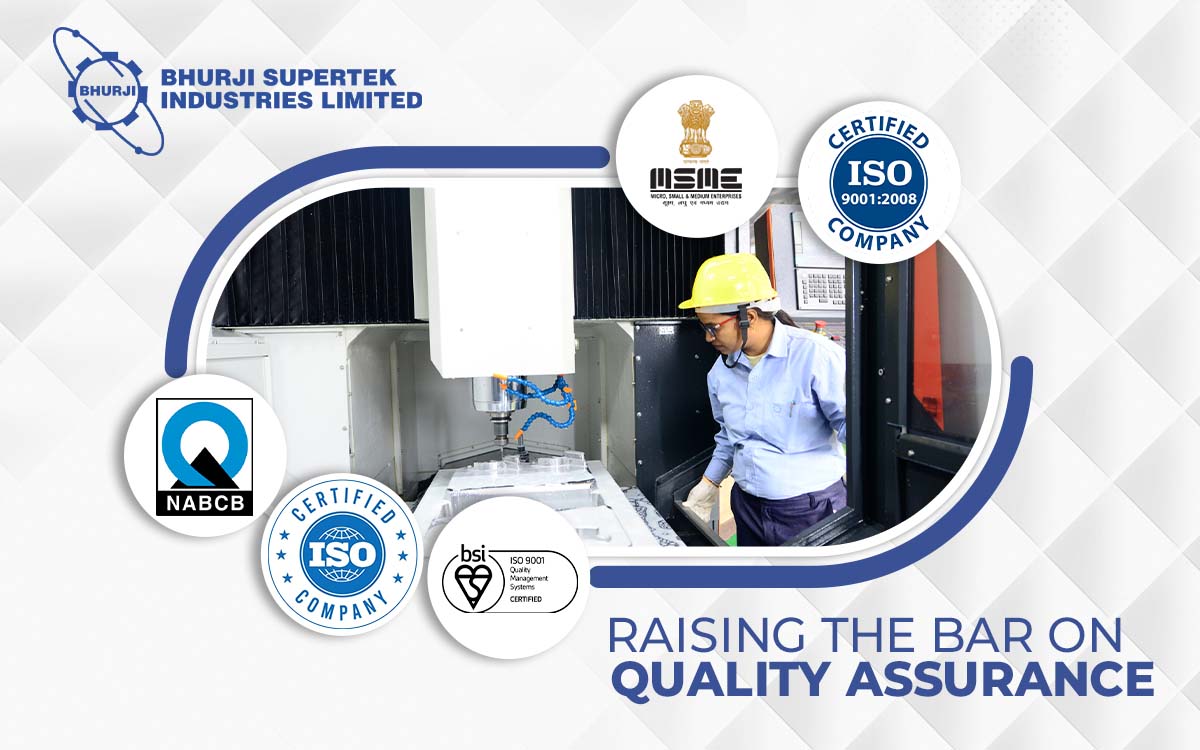
How Our Internal QA Protocols Go Beyond Industry Norms
In today’s competitive manufacturing ecosystem, quality is not just a metric—it’s a reputation. For Original Equipment Manufacturers (OEMs), especially in industries like cooling appliances, automotive, and high-precision plastic components, every micron matters. At Bhurji Supertek Industry Limited (BSIL), we don’t just meet industry standards—we exceed them, through a culture of uncompromising quality assurance.
Why Quality Assurance Isn’t Just a Department—It’s a Discipline
Most toolrooms and component manufacturers rely on standard QA protocols based on ISO or customer-defined parameters. While these standards ensure compliance, they often lack the granularity needed for real-world, high-performance use cases.
At BSIL, we treat Quality Assurance (QA) as a strategic pillar, not a post-production formality. Our QA team is embedded into the design, tooling, and production lifecycle, ensuring that quality is built-in, not just inspected out.
1. Early-Stage Involvement: Quality Begins at Design
Our QA journey starts not after the tool is built, but during product feasibility and DFM (Design for Manufacturing) analysis. Every drawing, CAD file, and simulation is reviewed from a production and post-production lens.
- Tolerances are proactively validated to match material behavior.
- Mould flow simulations help predict and eliminate shrinkage, warpage, and air traps.
- Tool material choices are reviewed for wear resistance and thermal balance.
This approach reduces the probability of rework, shortens development cycles, and protects OEMs from costly post-launch issues.
2. In-Process Quality Checks at Every Stage
Unlike traditional models where QA is performed after tool completion or part moulding, our system includes multi-level in-process quality checks:
- Raw Material Verification – All steel, inserts, and components are verified for grade, hardness, and supplier consistency before machining.
- Dimensional Validation During Machining – Key checkpoints during CNC machining, EDM, and polishing are measured using:
- Digital Verniers
Height Gauges
Micrometers
- Profile Projectors
- Digital Verniers
- Fitment Trials – Before assembly, every core, cavity, and insert is tested in dry runs to avoid assembly-level surprises.
This layered approach ensures that issues are detected early, minimizing last-minute troubleshooting.
3. Advanced Inspection Techniques
BSIL employs advanced measuring tools and inspection methods that go beyond traditional hand gauges:
- Coordinate Measuring Machine (CMM): Critical for verifying complex geometries, concentricities, and multiple axes.
- Surface Roughness Testers: To validate finishes where gloss, flow, or sealing is essential.
- Hardness Testing: Post-treatment validation for inserts and wear components.
- First Article Inspection (FAI): For every new mould, FAI is conducted and documented comprehensively before release.
These steps are not just documented for compliance, but digitally recorded for traceability, accessible for future audits or improvement initiatives.
4. Pre-Dispatch Validation (PDV): Final Line of Defense
Before dispatching any die, mould, or component, we conduct a PDV process that acts as a final validation barrier. This includes:
- Trial Production Runs on actual machines or test rigs.
- Inspection Reports with complete dimensional sheets and annotations.
- Packaging QA – Ensuring tooling is securely packed to prevent transit damage, a key concern for overseas dispatches.
No tool leaves our facility without QA head sign-off—even if it’s a repeat order.
5. Customer-Centric Quality Reporting & Feedback Loops
We understand that for OEM clients, transparency is just as important as performance. That’s why BSIL provides:
- Detailed QA Dossiers: Including material certificates, inspection records, and trial photos.
- Digital Approval Workflows: Customers can access QA reports online for real-time approvals.
- Feedback Integration: Post-delivery feedback, if any, is documented and used to calibrate internal SOPs and preventive checklists.
6. Compliance Is the Baseline. Performance Is the Goal.
BSIL is compliant with ISO 9001:2015, and our systems align with most global QA protocols. But our intent goes beyond ticking boxes—we aim to be a zero-defect partner to our clients. Our internal KPIs are stricter than client SLAs, and we continuously benchmark our systems against international best practices in precision manufacturing.
Final Thoughts
In high-precision manufacturing, quality isn’t an act—it’s a habit. At BSIL, our internal QA protocols are designed to protect your brand, elevate your product quality, and ensure smooth downstream production.
When you partner with us, you’re not just buying a tool or component—you’re investing in a system of engineered reliability.
Interested in how BSIL can bring engineering assurance to your product line?
Reach out to us for a walkthrough of our QA framework or request a sample inspection dossier.


Leave a Reply