
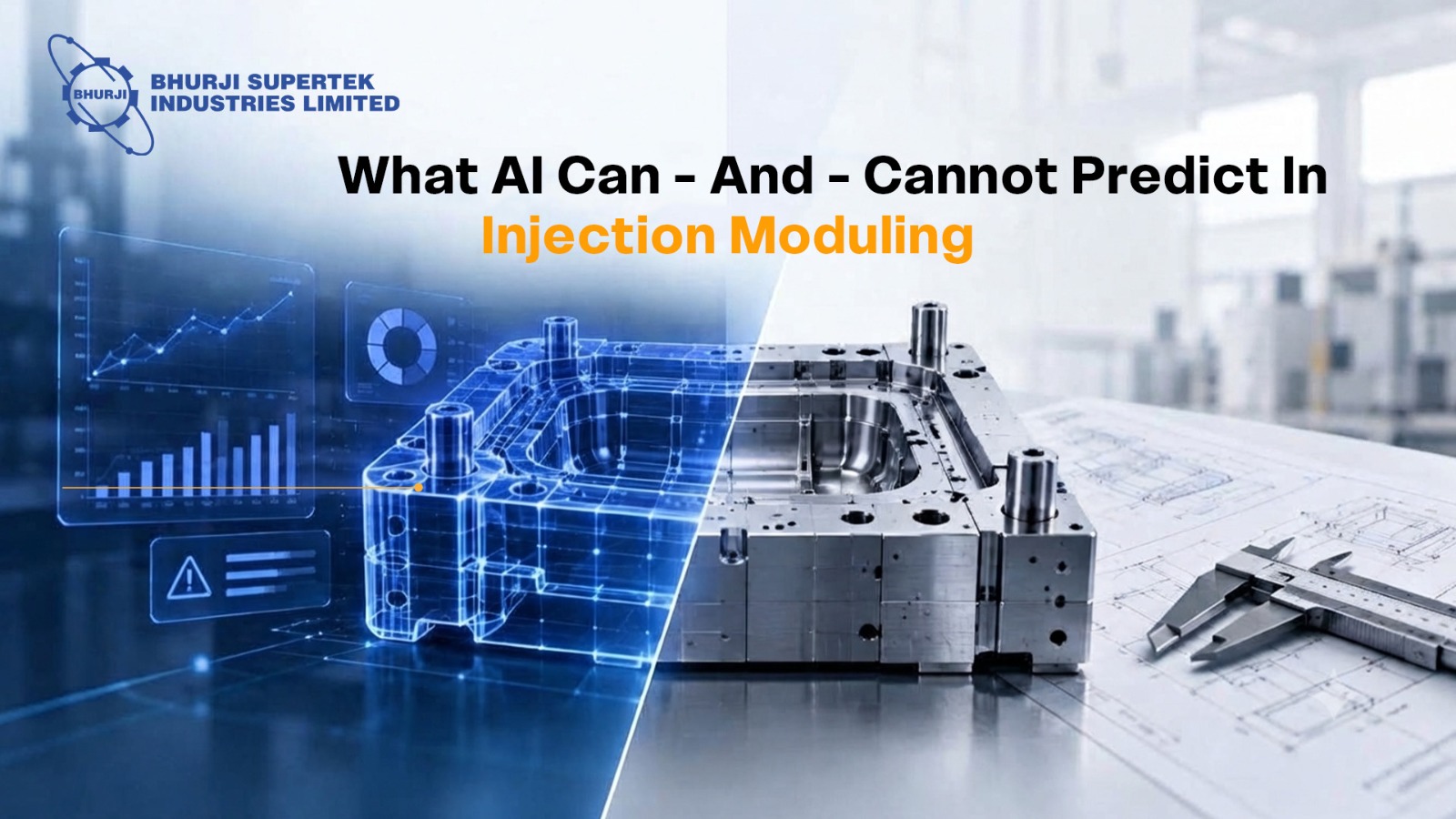
What AI Can—and Cannot—Predict in Injection Moulding
Artificial Intelligence is becoming increasingly relevant to modern manufacturing. In injection moulding, its potential is particularly significant because production involves a large number of interconnected variables—material behaviour, mould conditions, machine parameters, cooling, cycle time and environmental factors.
With enough reliable production data, AI can identify patterns that may not be immediately visible to the human eye. It can help manufacturers anticipate process variation, detect anomalies and improve production stability.
But there is an important distinction between predicting a pattern and understanding the engineering reason behind it.
AI can support injection moulding decisions. It cannot replace the engineering principles on which those decisions are built.
Where AI Can Add Real Predictive Value
1. Predicting Process Variation
Injection moulding is a repeatable process, but it is not completely static. Small changes in temperature, pressure, cycle time, material behaviour or machine performance can gradually influence the final component.
AI models can analyse historical production data and identify relationships between process parameters and quality outcomes. Over time, this can help predict when a process is beginning to move away from its established operating window.
For high-volume production, this is particularly valuable.
Instead of identifying variation only after components have been produced, manufacturers can potentially identify early signals that indicate where variation is likely to occur.
The value of AI is therefore not simply detecting defects—it is recognising the conditions that may lead to them.
2. Predicting Potential Defects
Injection moulding defects such as warpage, sink marks, short shots, flash and dimensional variation are influenced by multiple process and design parameters.
AI can learn from historical production and quality data to identify combinations of conditions that have previously been associated with specific defects.
For example, if a particular combination of injection speed, melt temperature and cooling behaviour has repeatedly resulted in dimensional instability, an AI system can flag similar conditions during future production.
This can support faster intervention and reduce dependence on purely reactive quality inspection.
However, AI predictions are only as reliable as the data behind them. If the production history does not adequately represent a particular material, mould design or operating condition, the prediction may not be meaningful.
3. Predictive Maintenance of Moulding Equipment
Maintenance is another area where AI can become increasingly useful
Injection moulding machines operate through repeated mechanical and thermal cycles. Changes in vibration, temperature, pressure, cycle time or energy consumption can sometimes indicate that equipment behaviour is changing.
AI-based predictive maintenance systems can compare current machine behaviour against historical patterns and identify unusual deviations.
This can help maintenance teams move from: “Something has failed.”
to: “The machine is showing signs that something may require attention.”
That difference can have a significant impact on downtime and production planning.
The same principle can increasingly be applied to mould-related data, particularly where tooling condition, cycle behaviour and maintenance history are systematically recorded.
4. Identifying Process Trends Over Time
One of AI’s strongest capabilities is its ability to analyse large volumes of data.
A production team may look at individual cycles, batches or inspection reports. An AI system can examine much larger datasets and identify relationships across thousands of production cycles.
This can reveal trends such as:
● Gradual changes in cycle time
● Increasing process variation
● Repeated quality deviations
● Changes in machine behaviour
● Correlation between process parameters and defects
● Patterns preceding unplanned stoppages
These insights can support more informed process optimisation and production planning.
But What Can AI Not Predict Reliably?
This is where the conversation around AI in injection moulding needs some balance. AI is powerful at recognising patterns within data. It is considerably less reliable when asked to predict situations that are fundamentally outside the data on which it was trained.
1. AI Cannot Replace Mould Engineering
A mould is not simply a collection of data points. Its performance depends on decisions involving part geometry, material flow, cooling, gating, ejection, tolerances, tooling construction and machine compatibility. AI can assist with simulations and identify patterns from previous moulding data, but it cannot independently replace engineering judgement when a completely new product or mould design is being developed. This is particularly important during product development, where there may be little or no historical production data available.
2. AI Cannot Fully Predict Unseen Material Behaviour
Material data can help AI models understand how a polymer has behaved under known conditions. But material behaviour can change with grade, additives, fillers, moisture, processing history and actual production conditions. A model trained on one material system cannot automatically be expected to make accurate predictions for another. Material selection and validation therefore remain engineering activities rather than purely data-driven decisions.
3. AI Cannot Eliminate the Need for Process Validation
A prediction is not the same as validation. An AI model may indicate that a particular combination of parameters is likely to produce a stable result. That prediction still needs to be verified through actual mould trials, testing and production conditions. This is particularly important for critical components where dimensional accuracy, functional performance and long-term consistency are non-negotiable. Testing and validation remain essential because manufacturing ultimately happens in the physical world—not inside the model.
4. AI Cannot Predict Every Unexpected Event
Manufacturing environments contain variables that may not always be captured in a dataset. A sudden material change, machine intervention, tooling modification, environmental variation or unexpected mechanical issue can create conditions that an AI model has never encountered. This is one of the fundamental limitations of predictive systems. AI is strongest when the future resembles the patterns contained in the past.
When conditions change significantly, engineering expertise becomes even more important.
The Future Is Not AI Versus Engineering
The more useful question is not whether AI will replace manufacturing engineers. It is how AI can make engineering teams more informed. In injection moulding, this could mean using AI to monitor production data, identify patterns, highlight anomalies and support predictive maintenance—while engineers continue to make decisions around mould design, material selection, process validation and production readiness. This combination is far more powerful than either approach on its own. For a tooling and injection moulding organisation, the objective should not be to introduce AI simply because it is a new technology. The objective should be to apply it where it can improve predictability, repeatability and decision-making.
Building the Right Foundation for AI
There is also a practical consideration that often gets overlooked. AI cannot create reliable manufacturing intelligence from unreliable data. Consistent data collection, defined process parameters, quality records, machine monitoring, tooling history and structured validation processes form the foundation on which useful AI applications can be built. This is why the maturity of the underlying manufacturing process matters as much as the technology itself. For organisations with established engineering, tooling and injection moulding systems, AI can become an additional layer of intelligence—helping teams understand production behaviour at a scale that would otherwise be difficult to analyse manually. At BSIL, this engineering foundation spans product design, mould development, engineering and simulation, prototyping, testing and validation, and manufacturing.
AI Can Predict. Engineering Still Decides.
The future of injection moulding will undoubtedly become more data-driven. AI will help manufacturers identify patterns earlier, predict potential process deviations and make production systems more responsive. But prediction alone does not create a reliable moulded component. The real advantage lies in combining data intelligence with engineering judgement. AI can tell us that something is likely to happen. Engineering helps us understand why—and, more importantly, what should be done about it. That is where the future of intelligent injection moulding is likely to be: not machines replacing engineers, but better data helping engineers make better decisions
Leave a Reply