
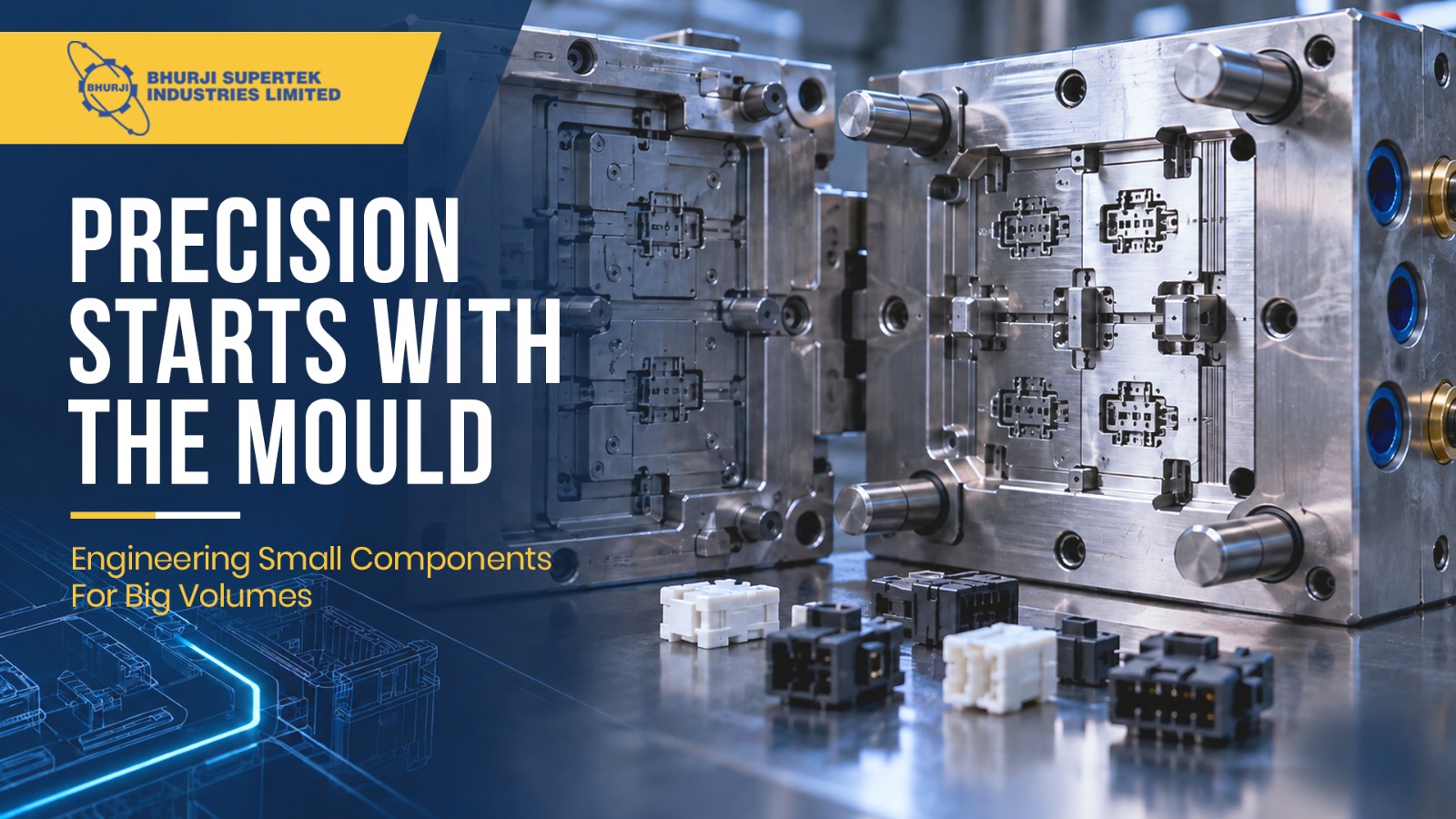
Mould Design for Connectors and Small Precision Components
Connectors may be small, but the components that enable electrical, electronic and electromechanical connections often demand a high level of dimensional accuracy and manufacturing consistency.
From automotive electronics and appliances to industrial equipment and consumer products, connectors and other small precision components are typically designed with intricate geometries, tight mating interfaces and functional features that need to be reproduced consistently across large production volumes.
This places particular importance on mould design for connectors and small precision components. The tooling must not only reproduce the component accurately but also support stable material flow, controlled cooling, reliable ejection and repeatable production over an extended mould life.
For manufacturers, precision begins with the way the mould is engineered.
Why Connector Mould Design Requires a Different Approach
A small component does not necessarily mean a simple component.
Connectors can incorporate thin sections, locking features, cavities, ribs, slots and intricate interfaces within a compact geometry. In many applications, these features directly influence assembly and functional performance.
The mould therefore needs to accommodate:
- Fine and intricate component features
- Tight dimensional requirements
- Consistent filling across cavities
- Controlled shrinkage and warpage
- Reliable ejection of delicate components
- High production volumes
- Repeatable performance over the tool lifecycle
The relationship between component design, material behaviour and mould architecture becomes particularly important when the component is small and the production volume is high.
Key Elements of Precision Mould Design for Connectors
1. Starting With the Component, Not Just the Tool
Effective tooling begins with a detailed understanding of the component and its intended function.
Before mould development, engineers need to assess features such as wall thickness, ribs, bosses, slots, undercuts, mating surfaces and assembly interfaces. These characteristics influence the parting line, core and cavity arrangement, gating, ejection and other aspects of the mould.
Design-for-manufacturing considerations at this stage can help identify opportunities to simplify tooling while preserving the functional requirements of the component.
The objective is to develop a mould architecture that supports both component functionality and production feasibility.
2. Cavity Configuration for High-Volume Components
Connectors and small plastic components are frequently produced in large quantities. This makes multi-cavity tooling an important consideration.
However, a higher cavity count introduces additional engineering requirements.
The cavity arrangement needs to support balanced filling, consistent cooling and uniform production conditions across the mould. Runner configuration, cavity positioning, mould strength and accessibility for maintenance all become part of the tooling decision.
For high-volume production, cavity-to-cavity consistency is particularly important. A component that performs correctly in one cavity must maintain the same dimensional characteristics across the complete mould.
3. Gate Location and Material Flow
In small components, the available flow path can be limited by intricate geometry and thin sections.
Gate position therefore needs to be considered in relation to the component’s geometry, material characteristics and functional surfaces. The objective is to achieve appropriate filling while controlling potential issues such as weld lines, air entrapment, pressure variation and differential shrinkage.
Mould flow analysis can provide valuable insight during the engineering stage by allowing filling behaviour, pressure requirements and potential flow-related considerations to be assessed before tool manufacturing.
This moves mould development from a predominantly trial-based process towards a more engineering-led approach.
4. Material Behaviour and Dimensional Stability
The choice of polymer has a direct influence on connector mould design.
Engineering plastics may have different flow characteristics, shrinkage rates, thermal properties and mechanical behaviour. Reinforced materials can introduce additional considerations because fibre orientation may influence dimensional stability and part performance.
For precision components, material behaviour needs to be considered when establishing:
- Shrinkage allowances
- Gate locations
- Flow paths
- Cooling strategy
- Cavity dimensions
- Expected dimensional variation
A mould cannot be engineered independently of the material it is intended to process.
5. Cooling in Small Precision Moulds
Cooling has a direct relationship with cycle time, dimensional stability and repeatability.
Small components often contain closely spaced features, which can restrict the space available for conventional cooling channels. The cooling system therefore needs to be planned around the cavity geometry while maintaining adequate thermal control.
Uniform cooling can help reduce variations associated with differential shrinkage and support more stable production cycles.
Where component geometry and production requirements justify it, advanced cooling approaches can also be considered during tooling development.
6. Ejection of Intricate Components
The ejection system is another important consideration in precision mould design.
Connectors and small components can contain delicate features that may be susceptible to deformation during ejection. Ejector positioning, pin size, ejection force and part geometry must therefore be considered together.
The ejection system should remove the component efficiently while protecting critical functional and cosmetic surfaces.
For automated production environments, predictable ejection also contributes to reliable part handling and downstream processes.
7. Venting Around Fine Features
Small and intricate cavities can create areas where trapped air becomes difficult to evacuate.
Appropriate venting allows displaced air to escape as the cavity fills, supporting more consistent filling and replication of fine component features.
Venting strategy needs to be developed with consideration for the component geometry, material and expected filling behaviour.
For connectors with narrow sections and detailed features, effective air evacuation can be particularly important to achieving consistent mould filling.
8. Tool Construction and Expected Production Life
Connector moulds are often expected to support high production volumes. This means mould construction needs to be considered in relation to the expected production lifecycle.
Factors such as tool steel, inserts, wear resistance, surface treatment, component geometry and maintenance accessibility can influence long-term mould performance.
The appropriate tooling approach therefore depends not only on the component being manufactured, but also on factors such as:
- Annual production volume
- Expected mould life
- Material being processed
- Cavity count
- Component complexity
- Maintenance requirements
- Production environment
The goal is to develop a production tool that remains capable of delivering the required component quality throughout its intended operating life.
9. Designing for Automated Production
Small precision components are well suited to highly automated production environments, where moulding, part removal, inspection and assembly can be integrated into a production cell.
This creates another consideration for mould development.
Consistent ejection, predictable cycle behaviour and repeatable component positioning can support automation and reduce variation between production cycles.
Consequently, connector mould design should increasingly be considered as part of the overall production system rather than as an isolated tooling exercise.
10. Validation Before Production
For precision components, producing a first acceptable part is only one stage of tooling validation.
The mould must demonstrate its ability to reproduce the required component consistently under defined production conditions.
Depending on the application, validation can include:
- Mould flow analysis
- Initial mould trials
- Dimensional inspection
- Cavity-to-cavity comparison
- Functional checks
- Process optimisation
- Production validation
This engineering approach helps establish whether the mould is ready not simply to produce components, but to support the required production volume and consistency.
From Precision to Repeatability
Precision tooling is ultimately about more than achieving a particular dimension once.
A production mould may be expected to manufacture hundreds of thousands or millions of components during its working life. The real requirement is therefore the ability to repeat the intended geometry consistently across cycles and throughout the tool lifecycle.
This is particularly important for connectors, where dimensional variation in mating features, locking mechanisms or interfaces can influence downstream assembly and product performance.
Mould design must consequently bring together component geometry, material behaviour, cavity configuration, flow, cooling, ejection and tool construction as one integrated engineering consideration.
Applications Across Industries
Small precision injection-moulded components are used across a wide range of industries, including:
- Automotive: electrical connectors, sensor components and electronic interfaces
- Electrical & Electronics: connectors, switches, terminals and housings
- Home & Kitchen Appliances: electrical interfaces, functional components and internal assemblies
- Lighting: electrical interfaces, holders and precision plastic components
- Industrial Equipment: connectors, terminals and functional components
- Consumer Products: small mechanical and assembly components
Each application can bring different requirements for dimensional accuracy, material performance, production volume and component functionality. The mould therefore needs to be engineered around the specific application rather than treated as a standard tooling configuration.
Frequently Asked Questions
What is connector mould design?
Connector mould design is the engineering of an injection mould specifically to manufacture plastic connector components with the required geometry, dimensional accuracy, material behaviour and production consistency.
What makes small precision components difficult to mould?
Small components can contain intricate features, thin sections and tight dimensional requirements within a limited geometry. Consistent filling, cooling, ejection and cavity-to-cavity performance therefore become important considerations.
Why is multi-cavity tooling used for connectors?
Connectors are often manufactured in high production volumes. Multi-cavity tooling can increase output per moulding cycle while supporting the production requirements of large-volume applications, provided the mould is engineered for balanced and consistent performance.
How does material selection affect connector mould design?
Different polymers have different flow, shrinkage, thermal and mechanical characteristics. These properties influence cavity dimensions, gating, cooling, material flow and dimensional stability.
What role does simulation play in connector mould development?
Simulation, including mould flow analysis, can help engineers evaluate filling behaviour, pressure, flow patterns and other factors before the physical tool is manufactured. This supports more informed tooling decisions during the design stage.
How does BSIL approach precision mould development?
Bhurji Supertek Industries Limited combines product understanding, tooling engineering, simulation, prototyping, validation and manufacturing capabilities to develop mould solutions for demanding production applications.
Conclusion
The compact size of a connector or precision component can conceal the complexity involved in manufacturing it consistently.
Effective mould design for connectors and small precision components requires a coordinated approach to component geometry, cavity configuration, material behaviour, gating, cooling, venting, ejection and validation.
When these elements are engineered together, the mould becomes more than a means of reproducing a component. It becomes the foundation for repeatable, scalable and production-ready manufacturing.
For industries where small components play a critical role in the final product, precision tooling can make a significant difference to production consistency and long-term manufacturing performance.

Leave a Reply