
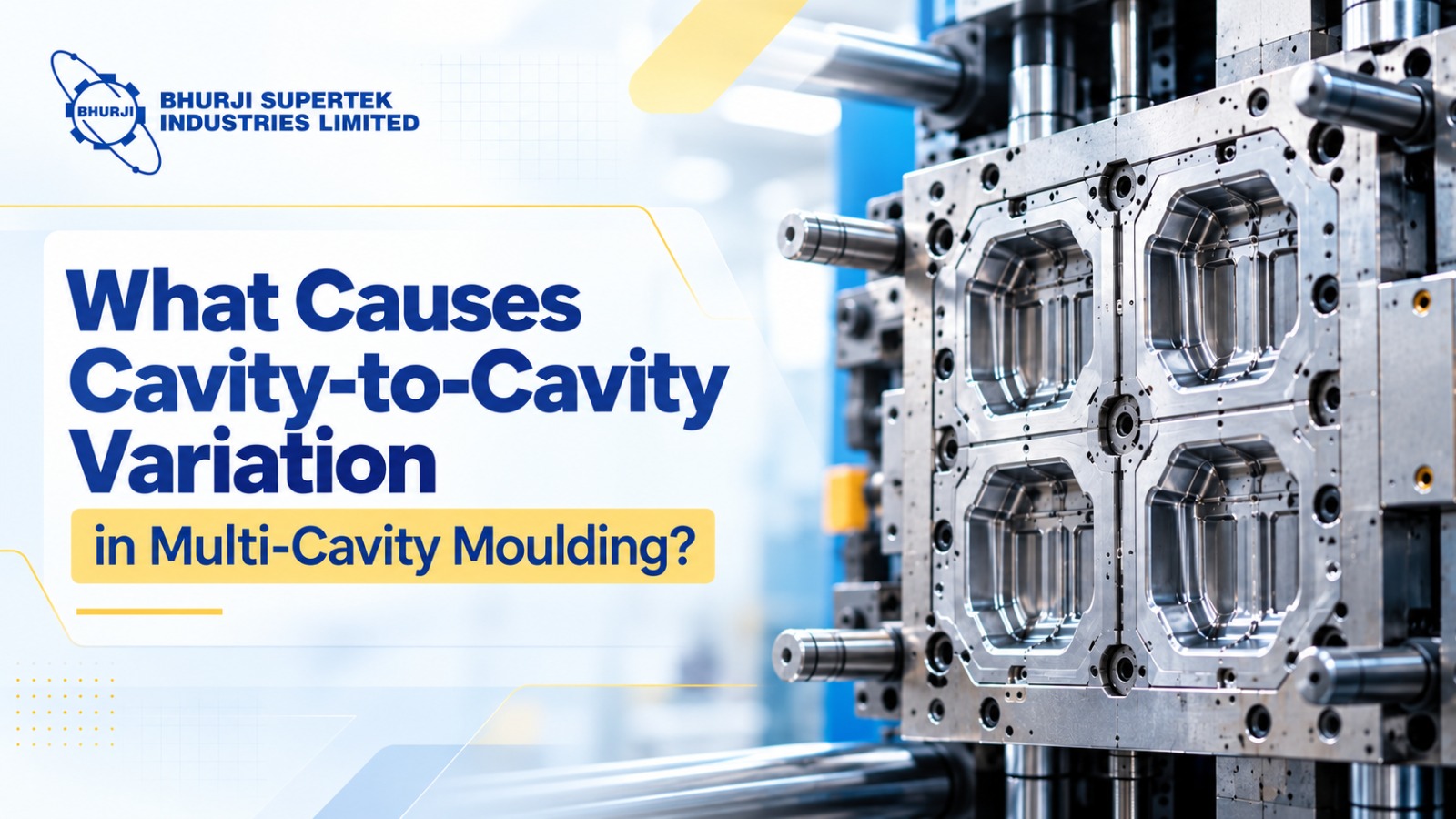
What Causes Cavity-to-Cavity Variation in Multi-Cavity Moulding?
Multi-cavity moulds are designed to produce multiple components in every injection cycle. In
theory, each cavity should receive the same material, experience similar processing
conditions and produce parts with consistent dimensions and appearance.
In practice, however, cavity-to-cavity variation can occur even when all cavities are part of
the same mould and the machine is operating under the same set of parameters
One cavity may produce a component that is slightly heavier. Another may show
dimensional variation, a different filling pattern or a higher tendency for a particular moulding
defect.
This raises an important question:
If the machine settings are identical, why aren’t the parts identical?
The answer often lies in what happens between the injection unit and each individual cavity.
The Role of Flow Balance
One of the most important factors in multi-cavity moulding is melt-flow balance.
In a well-designed mould, the runner and gating system should distribute molten material to
the cavities as consistently as possible. If the flow path to one cavity offers greater
resistance than another, the cavities may not fill under exactly the same conditions
Differences in runner length, runner diameter, gate dimensions or flow resistance can
influence how quickly material reaches each cavity.
This can lead to differences in:
● Filling time
● Pressure requirements
● Packing conditions
● Part weight
● Dimensional stability
● Surface appearance
A mould may therefore be geometrically symmetrical while still being functionally unbalanced
from a flow perspective.
Gate Design Can Influence Cavity Variation
The gate is the point through which molten plastic enters the cavity, making its design
particularly important.
Small differences in gate size, position or condition can change how material enters a cavity.
As the mould continues through repeated production cycles, gate wear or deposits can also
influence the flow behaviour.
A cavity with a restricted gate may fill differently from another cavity with a more open flow
path.
This is why gate design needs to be considered not only from the perspective of filling the
part, but also from the perspective of maintaining consistency across all cavities.
Cooling Is Not Always Uniform
Cooling is another major contributor to cavity-to-cavity variation.
Once molten polymer enters the mould, heat must be removed in a controlled and consistent
manner. If cooling conditions differ between cavities, the parts may experience different rates
of solidification and shrinkage.
Variations can arise from differences in:
● Cooling channel layout
● Water flow
● Cooling temperature
● Local heat concentration
● Distance between cooling channels and cavity surfaces
Even relatively small differences in cooling effectiveness can influence dimensions, warpage
and cycle stability.
For this reason, cooling design is not simply about achieving an acceptable cycle time. It is
also about creating consistent thermal conditions across the mould.
Pressure and Packing Behaviour Matter
Filling the cavities is only part of the process.
After filling, packing pressure helps compensate for material shrinkage as the polymer cools.
If cavities do not experience comparable pressure conditions, differences in part weight and
dimensions can emerge.
Flow imbalance can contribute to differences in pressure distribution. The location and timing
of gate freeze can also affect how effectively packing pressure reaches individual cavities.
This means that two cavities can technically be filled during the same cycle while
experiencing different pressure histories.
The result may only become visible during dimensional inspection or functional testing.
Material Behaviour Can Add Another Variable
The material itself can also contribute to variation.
Different materials—and even different batches or grades of the same polymer—can exhibit
differences in viscosity, shrinkage and thermal behaviour.
Material preparation is therefore important in maintaining consistent moulding conditions.
Moisture content, material degradation and variations in regrind proportion can also
influence processing behaviour.
When a multi-cavity mould is already operating close to its process limits, relatively small
material changes can make cavity-to-cavity differences more noticeable.
Mould Temperature and Machine Conditions
The mould is part of a larger processing system.
Changes in mould temperature, melt temperature, injection speed, holding pressure or cycle
time can affect cavity filling and solidification.
Machine performance also matters. Pressure response, screw behaviour and temperature
control need to remain sufficiently stable for the process to remain repeatable.
However, it is important not to assume that changing machine parameters will automatically
solve cavity variation.
If the underlying cause is a runner imbalance, gate restriction or cooling difference, adjusting
machine settings may simply mask the issue rather than eliminate it.
Tool Wear and Maintenance Can Change Cavity Behaviour
A multi-cavity mould does not remain exactly the same throughout its production life.
Gates can wear. Venting can deteriorate. Inserts can develop wear. Cooling passages can
accumulate deposits. Moving components can gradually lose their original condition.
These changes may not affect every cavity equally.
Consequently, a mould that initially produced highly consistent components can develop
cavity-to-cavity variation over time.
This is why mould maintenance should not only focus on whether the tool is operational. It
should also consider whether each cavity continues to perform within the required production
window.
Venting Is Often Overlooked
Air trapped inside a cavity needs an effective path to escape as molten material enters.
If venting differs between cavities, filling behaviour can also differ. Poor or restricted venting
can contribute to incomplete filling, burn marks, surface defects or changes in filling
pressure.
Because venting is often less visible than runners and gates, it can be overlooked when
investigating cavity variation.
Yet in a multi-cavity mould, consistent venting is another part of maintaining consistent filling
behaviour.
How Should Cavity-to-Cavity Variation Be Investigated?
The first step should be to establish which cavity is actually behaving differently.
Instead of looking only at the final part, manufacturers can compare cavities using
parameters such as:
● Part weight
● Critical dimensions
● Filling behaviour
● Visual defects
● Pressure response
● Cooling conditions
● Gate condition
● Cycle consistency
This helps separate a mould-design issue from a process issue, material issue or
maintenance-related issue.
The objective should not simply be to adjust the machine until all parts appear acceptable.
The objective is to understand why the cavities are behaving differently.
Designing for Consistency From the Start
Cavity-to-cavity consistency begins well before the mould reaches production.
Runner balancing, gate design, cooling-channel layout, venting, cavity geometry and tooling
tolerances all contribute to the eventual behaviour of a multi-cavity mould.
Simulation and engineering analysis can help identify potential flow and cooling differences
during mould development. But these predictions should ultimately be validated through
mould trials and production data.
A well-designed multi-cavity mould is therefore not simply one that can produce multiple
parts in one cycle.
It is one where the multiple cavities behave predictably and consistently throughout
production.
Consistency Is the Real Measure of a Multi-Cavity Mould
The productivity advantage of multi-cavity moulding comes from producing more
components per cycle. But that advantage is meaningful only when the components meet
the same required specifications.
Cavity-to-cavity variation can originate from several interacting factors—flow balance, gate
design, cooling, packing, material behaviour, venting, machine conditions and tooling wear.
Identifying the actual cause requires looking beyond the machine settings and understanding
the complete moulding system.
In multi-cavity moulding, consistency is not created by having identical cavities alone.
It is created by ensuring that every cavity receives—and responds to—the process in
a sufficiently consistent way

Leave a Reply