
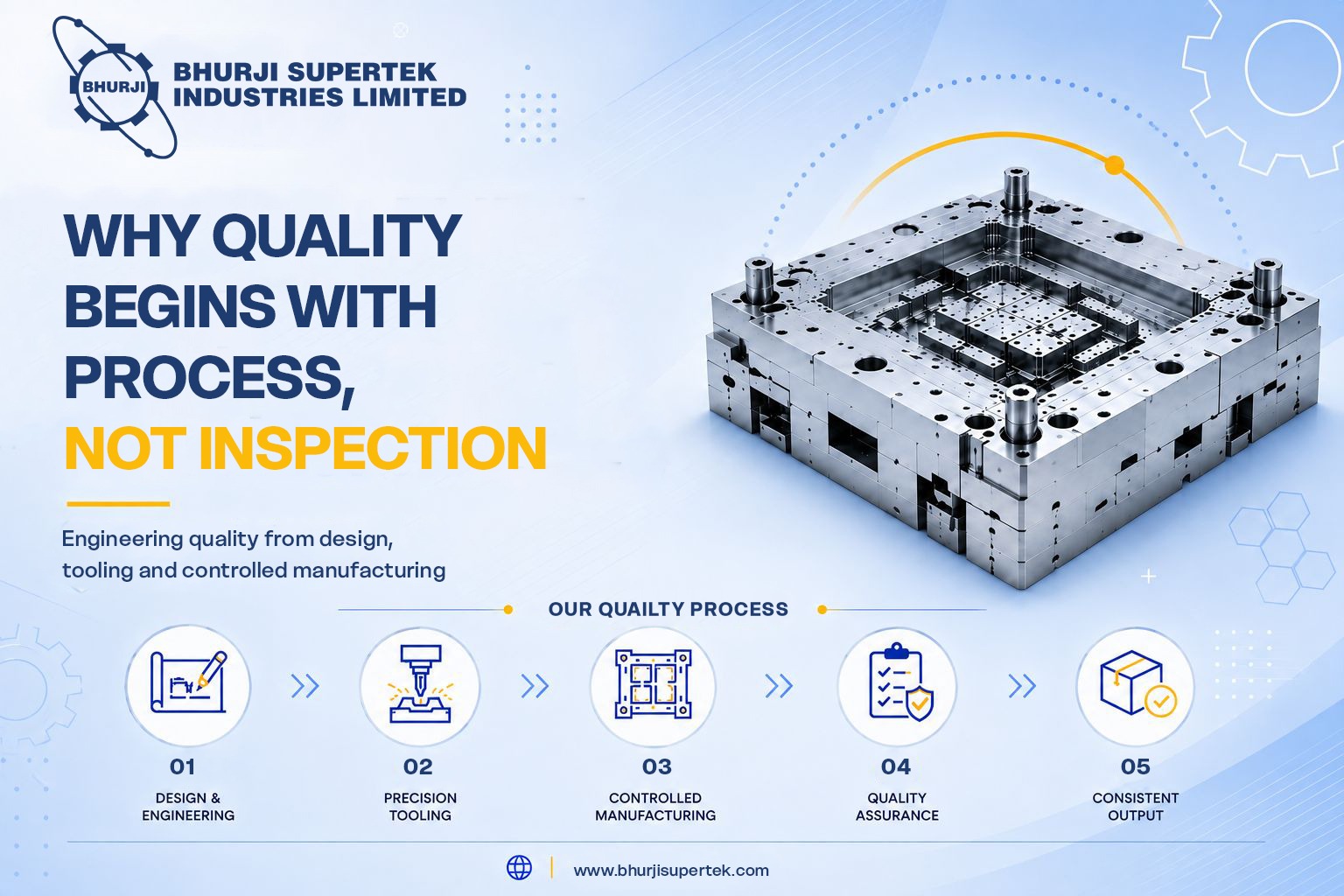
Why Quality in Manufacturing Begins with Process, Not Inspection?
Introduction
In manufacturing, quality has traditionally been associated with inspection. Products are measured, tested and verified before they leave the factory, creating the perception that quality is achieved during the final stage of production. While inspection remains an important part of manufacturing, modern production environments have fundamentally changed the way leading manufacturers approach quality.
Today, quality is no longer viewed as an activity performed after production. It is recognised as the outcome of a well-designed, controlled and repeatable manufacturing process.
For OEMs, this distinction is significant. A manufacturing partner capable of consistently producing high-quality components is not one that performs extensive inspection—it is one that has engineered quality into every stage of product development and production.
In an era where product lifecycles are becoming shorter, customer expectations continue to rise and manufacturing complexity is increasing, businesses cannot afford to rely solely on defect detection. Instead, they must focus on defect prevention through robust processes, disciplined engineering and continuous improvement.
Understanding the Difference Between Inspection and Quality
Inspection and quality are often used interchangeably, but they represent two very different philosophies.
Inspection answers one question:
“Does this component meet specification?”
Quality asks a much broader question:
“What systems, processes and engineering decisions ensure every component consistently meets specification?”
This distinction is critical.
Inspection identifies defects after they occur. It validates the finished product and prevents non-conforming parts from reaching the customer.
However, inspection does not explain why the defect occurred, nor does it eliminate the conditions that caused it.
A mature manufacturing organisation therefore focuses on building processes that minimise variation from the very beginning.
Inspection verifies quality; process creates it.
Why Inspection Alone Is Not Enough
Imagine a production line manufacturing 50,000 plastic components for an OEM.
At the end of production, the quality team discovers dimensional inconsistencies in 8% of the batch.
Inspection has successfully identified the problem.
But by this stage:
- Raw materials have already been consumed.
- Machine hours have been utilised.
- Labour costs have been incurred.
- Delivery schedules may be affected.
- Rework or rejection adds further cost.
The financial impact extends well beyond the rejected parts.
This is why modern manufacturers are shifting from quality control to quality assurance, focusing on preventing defects rather than simply identifying them.
For OEMs operating in competitive markets, prevention is significantly more valuable than correction.
Quality Begins During Product Design
One of the biggest misconceptions is that quality starts on the production floor.
In reality, it starts much earlier.
A product’s manufacturability is largely determined during the design phase.
Engineering decisions regarding wall thickness, draft angles, material selection, tolerance allocation, assembly requirements and functional performance all influence manufacturing stability.
When manufacturing teams are involved early, potential production challenges can often be eliminated before tooling even begins.
This collaborative approach, commonly referred to as Design for Manufacturability (DFM), reduces production risks, shortens development cycles and improves long-term product quality.
Many quality issues that appear during production actually originate from design decisions made months earlier.
Precision Tooling Forms the Foundation of Process Quality
For plastic injection moulding and precision manufacturing, tooling plays a defining role in product quality.
Even the most advanced moulding machines cannot consistently produce accurate components if the tool itself introduces variation.
Precision tooling influences:
- Dimensional accuracy
- Surface finish
- Part repeatability
- Cycle consistency
- Tool life
- Production efficiency
A well-designed tool reduces process variability and enables manufacturers to maintain quality across thousands—or even millions—of production cycles.
This is why leading OEMs view tooling as a strategic investment rather than simply a production expense.
Process Control Creates Predictable Outcomes
Every manufacturing process contains variables.
Material temperature.
Injection pressure.
Cooling time.
Machine parameters.
Environmental conditions.
Operator practices.
If these variables are not controlled, product variation becomes inevitable.
Modern manufacturing therefore relies heavily on process control rather than operator intervention.
Validated process parameters, machine monitoring, standard operating procedures and preventive maintenance ensure that every production cycle operates within predefined limits.
The result is a stable manufacturing process capable of delivering repeatable quality over long production runs.
For OEMs, this means fewer deviations, reduced rejection rates and greater confidence in production planning.
Why Repeatability Matters More Than a Perfect Sample
Producing one perfect component is an achievement.
Producing one million identical components is manufacturing excellence.
Customers rarely evaluate suppliers based on prototype quality alone.
They evaluate consistency.
Can the manufacturer deliver the same dimensional accuracy six months later?
Will replacement tools maintain the same quality?
Can production continue without unexpected variation?
Repeatability is where mature manufacturing systems demonstrate their true capability.
It reflects the effectiveness of tooling, process validation, maintenance systems and quality management practices working together.
Data Is Transforming Quality Management
Quality is becoming increasingly data-driven.
Manufacturers today analyse process capability, machine performance, rejection trends and production variability in real time.
Rather than waiting for defects to appear, production data allows engineering teams to identify trends before they become problems.
This shift enables predictive decision-making instead of reactive troubleshooting.
Data-driven manufacturing also supports continuous improvement by highlighting opportunities to optimise cycle times, reduce waste and improve process capability.
The Role of Continuous Improvement
Quality is never a one-time achievement.
Customer expectations evolve.
Materials change.
Products become more sophisticated.
Manufacturing technologies continue to advance.
Consequently, every manufacturing process requires regular evaluation and refinement.
Root cause analysis, corrective actions, preventive maintenance, employee training and process optimisation all contribute to a culture of continuous improvement.
Organisations that consistently review and strengthen their manufacturing processes achieve higher levels of operational stability while reducing long-term production costs.
Why OEMs Should Evaluate Manufacturing Processes—Not Just Products
When selecting a manufacturing partner, many organisations naturally review sample components and quality certifications.
Equally important, however, is understanding how that quality is achieved.
Questions worth asking include:
- How are manufacturing processes validated?
- What systems are in place to monitor process stability?
- How is tooling maintained?
- How are engineering changes managed?
- What mechanisms drive continuous improvement?
- How is production consistency ensured across high-volume manufacturing?
The answers provide valuable insight into a manufacturer’s ability to consistently deliver quality over the lifecycle of a product.
Conclusion
Quality in manufacturing is not created during inspection.
Inspection remains essential because it confirms compliance and protects customers from defects. However, by the time inspection identifies a problem, the opportunity to prevent it has already passed.
Sustainable manufacturing excellence comes from disciplined engineering, precision tooling, validated processes, controlled production environments and a commitment to continuous improvement.
For OEMs, the most reliable manufacturing partners are not those who inspect the most—they are those whose processes consistently produce quality from the very first cycle to the millionth.
Ultimately, quality is not a checkpoint at the end of production. It is the outcome of every engineering, tooling and manufacturing decision made throughout the product lifecycle.

Leave a Reply