
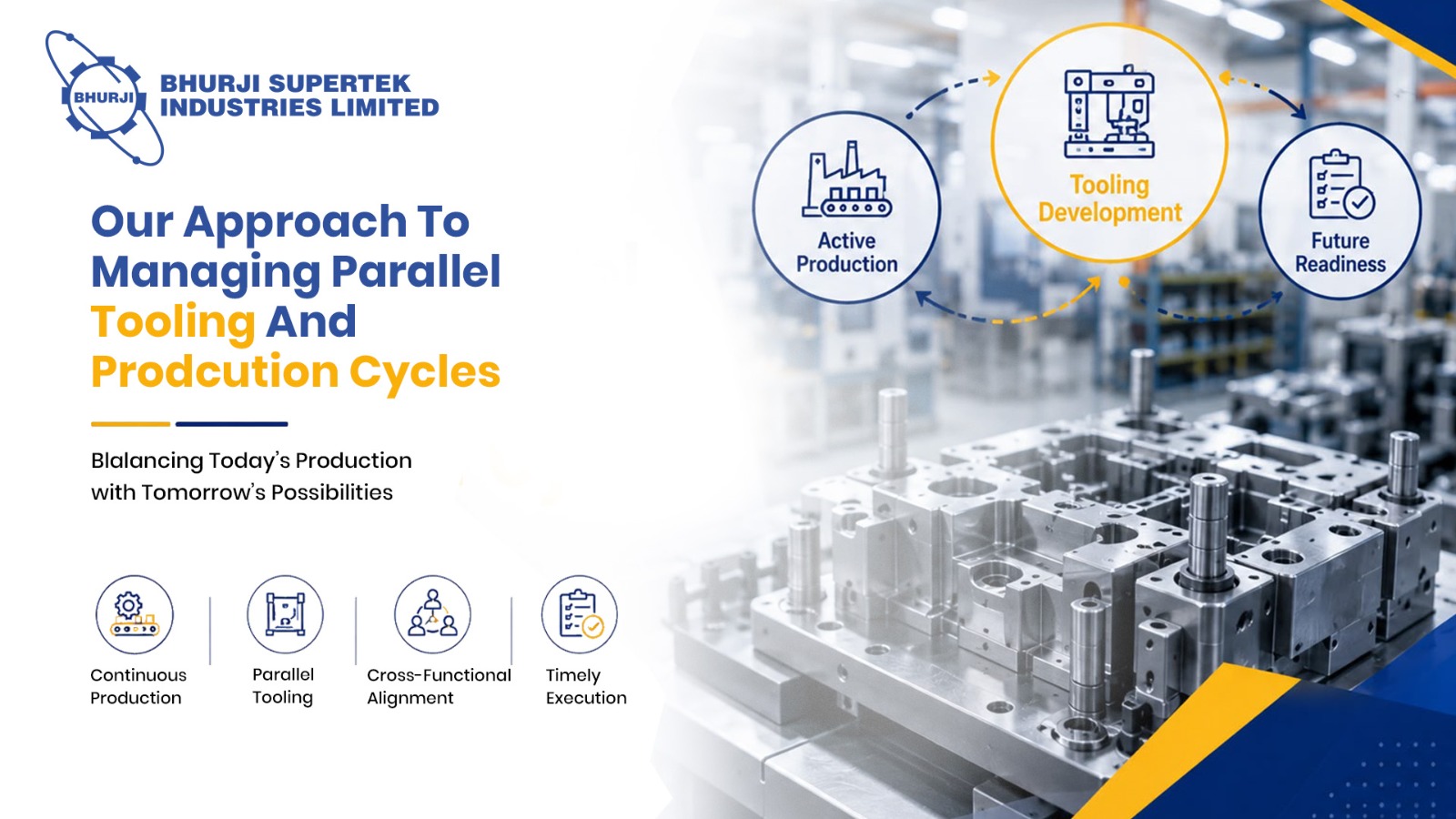
Our Approach to Managing Parallel Tooling and Production Cycles
In manufacturing, new product development and ongoing production are often viewed as separate activities.
In reality, they rarely operate independently.
For most established OEM manufacturers, production never pauses to accommodate development. Existing programs continue to serve customers while new products, engineering changes, tooling projects, and future manufacturing requirements are simultaneously moving through their own lifecycle.
This creates a unique operational reality.
Manufacturers are not simply responsible for producing today’s products.
They must also prepare for tomorrow’s products without compromising today’s commitments.
Successfully managing these parallel cycles requires far more than additional capacity. It demands planning discipline, cross-functional coordination, tooling expertise, and a manufacturing ecosystem capable of balancing immediate execution with future readiness.
As product development timelines continue to compress across industries, the ability to manage tooling development alongside active production has become an increasingly important differentiator.
Manufacturing Exists in Multiple Time Horizons
One of the most overlooked aspects of modern manufacturing is that organizations often operate across several timelines simultaneously.
Production teams focus on current customer requirements.
Tooling teams work on upcoming product programs.
Engineering teams evaluate future product improvements.
Procurement teams align sourcing strategies for both present and future demand.
Project management teams coordinate milestones that may span months or even years.
At any given moment, these activities overlap.
A production line may be manufacturing components from a tool that has been running successfully for years, while nearby teams are validating an entirely new tool designed for a future product generation.
From the outside, manufacturing appears linear.
Internally, it is highly parallel.
The challenge is not simply executing multiple activities.
The challenge is ensuring that one activity does not negatively influence another.
Why Parallel Tooling Requires More Than Tool Manufacturing
When organizations discuss tooling programs, conversations often focus on design, machining, assembly, and trials.
These activities are certainly important.
However, in active manufacturing environments, tooling projects introduce additional considerations.
Machine availability.
Validation schedules.
Resource allocation.
Quality planning.
Engineering reviews.
Production priorities.
Each new tooling project must be integrated into an environment where existing commitments remain active.
The objective is not only to build the tool successfully.
It is to build the tool successfully while maintaining production continuity.
This distinction is what separates isolated tooling development from integrated manufacturing execution.
Planning Begins Long Before Tool Construction
One of the key principles in managing parallel tooling and production cycles is early planning.
Tooling programs do not begin when steel enters the machine shop.
They begin much earlier.
Manufacturing feasibility assessments.
Capacity evaluations.
Timeline alignment.
Material considerations.
Validation requirements.
Project milestones.
All of these factors influence how tooling activities will coexist with production operations.
The earlier these interactions are understood, the more effectively resources can be aligned.
This reduces operational friction and creates greater predictability throughout the project lifecycle.
In many cases, successful execution is less about accelerating activities and more about sequencing them intelligently.
Cross-Functional Visibility Is Essential
Tooling projects affect multiple functions simultaneously.
Engineering teams evaluate manufacturability.
Production teams assess implementation requirements.
Quality teams establish validation plans.
Procurement teams coordinate supplier readiness.
Project managers oversee timelines and milestone adherence.
When these activities operate independently, execution becomes increasingly difficult.
When visibility is shared across functions, decisions become more coordinated.
This is particularly important during product transitions, engineering modifications, and new program introductions where timing and alignment play a significant role in overall success.
The strongest manufacturing organizations are often those where information moves as efficiently as materials.
Production Stability Must Remain Non-Negotiable
One of the biggest risks in parallel program execution is allowing future initiatives to disrupt current performance.
While new tooling projects may be strategically important, ongoing production remains the foundation of customer confidence.
Delivery commitments continue.
Quality expectations remain unchanged.
Production schedules must still be achieved.
As a result, tooling development should be integrated into manufacturing systems in a way that protects production stability rather than competes with it.
This requires disciplined planning around machine utilization, technical resources, validation activities, and implementation schedules.
The goal is balance.
Future readiness should strengthen current operations—not compromise them.
Validation Creates the Bridge Between Development and Production
The transition from tooling completion to production readiness is often one of the most critical phases of a program.
This is where design intent meets manufacturing reality.
Tool trials.
Dimensional verification.
Process optimization.
Assembly validation.
Quality approvals.
Performance evaluations.
Each activity contributes to ensuring that a new tool is capable of supporting production requirements consistently and reliably.
In organizations managing multiple programs simultaneously, validation becomes more than a technical process.
It becomes a coordination process.
A successful transition depends not only on the quality of the tool itself but also on the readiness of the manufacturing ecosystem surrounding it.
Managing Complexity Through Process Discipline
As product portfolios expand and development cycles accelerate, parallel tooling and production activities naturally become more complex.
The solution is rarely found in additional resources alone.
Instead, sustainable execution depends on process discipline.
Clear project governance.
Defined milestone reviews.
Structured communication channels.
Resource planning.
Risk assessment.
Cross-functional accountability.
These systems create the visibility necessary to manage multiple priorities without losing focus on operational objectives.
In many ways, manufacturing maturity is reflected in how effectively an organization manages competing demands without compromising execution.
Looking Beyond Individual Projects
Tooling programs are often viewed as discrete initiatives with defined start and end points.
However, from a manufacturing perspective, each tooling project contributes to a much larger ecosystem.
New tools support future products.
Future products support business growth.
Business growth depends upon production stability.
Production stability depends upon disciplined execution.
The relationship between tooling and production is therefore not sequential—it is continuous.
Managing these parallel cycles effectively requires an understanding that every tooling decision ultimately influences future manufacturing performance.
Conclusion
Modern manufacturing is no longer defined solely by the ability to produce efficiently.
It is increasingly defined by the ability to prepare for future requirements while continuing to deliver on present commitments.
Managing parallel tooling and production cycles requires careful planning, strong project governance, cross-functional collaboration, and a disciplined approach to execution.
When these elements work together, organizations are able to introduce new programs, support evolving customer requirements, and maintain production continuity without sacrificing quality or reliability.
At BSIL, we view tooling development and production execution as interconnected disciplines rather than separate functions. By aligning engineering, tooling, project management, quality, and manufacturing teams from the earliest stages, we work to ensure that future programs are developed with the same focus on consistency and operational excellence that supports our ongoing production commitments.
Leave a Reply